
Building AI futures worth wanting

This feature was originally published on Enlightened.
Dr Emily Sullivan discusses how the Centre for Technomoral Futures is helping ensure AI serves society, protects human values and creates futures worth wanting.
Artificial intelligence is becoming increasingly embedded in everyday life, but as these technologies develop, questions about how they should be designed and used are becoming more important too.
At the University of Edinburgh’s Centre for Technomoral Futures (CTMF), researchers from different disciplines are working together to explore how technology can contribute to sustainable, just and ethical futures.
We spoke to Dr Emily Sullivan, Co-Director of the Centre for Technomoral Futures, about how AI is changing our lives, the questions society should be asking and why the future of technology is not inevitable.
Q: AI seems to be appearing everywhere at the moment. What do you think is the biggest change AI is already making to everyday life?
Emily: We can’t go on our computers or do simple searches online without AI influencing us. Many computers have AI assistants built into their operating systems that are said to improve efficiency and enhance our experience. Every Google search comes with an AI overview, without a clear way of turning the feature off. And these are just two examples that are in plain sight.
AI is also having an impact in ways that are more hidden, from government agencies using it for fraud detection to doctors using it to summarise clinical visits.
However, while it seems like AI itself has changed our current landscape, it is really a particular subset of AI: large language models. ‘AI’ is a term that covers a wide range of computational systems, many of which have been used across society for decades. More traditional decision-support systems analyse data for specific tasks, such as rule-based systems that help support everyday railway logistics.
These systems, while very important to many sectors, did not create the overwhelming sense of AI being everywhere. It is only now that AI has become synonymous with large language models – the basis for Google’s AI Overviews and products like ChatGPT – that it has started to feel all-encompassing.
One difference is that large language models are general-purpose. They are increasingly held up as the solution to all kinds of problems. They promise to solve labour shortages, increase access to social goods and even help solve climate change.
It is important to understand that many people, when talking about ‘AI’, are really referring to large language models rather than other types of AI systems that have been used for decades. Large language models introduce new risks and call for new ways of mitigating potential harms.
Q: What are ‘technomoral futures’?
Emily: Creating technomoral futures means striving for futures where technology is designed and used in ways that improve human flourishing, rather than in ways that eat away at human rights, contribute to climate collapse or create greater social exclusion.
At CTMF, we view technology as an opportunity to contribute to human flourishing by intentionally designing and implementing technologies with values that contribute to social wellbeing. We actively research which values contribute to this goal and ways of designing technology to serve these ends. We also research what kinds of social infrastructure need to be in place to ensure technology serves these goals.
Alongside our research, CTMF engages in public outreach, and our affiliates have strong connections with regulatory bodies, NGOs and industry so that our work can have an impact beyond academia. It is a testament to the deep expertise at the University of Edinburgh and among our researchers at CTMF that this research is able to have such an impact.
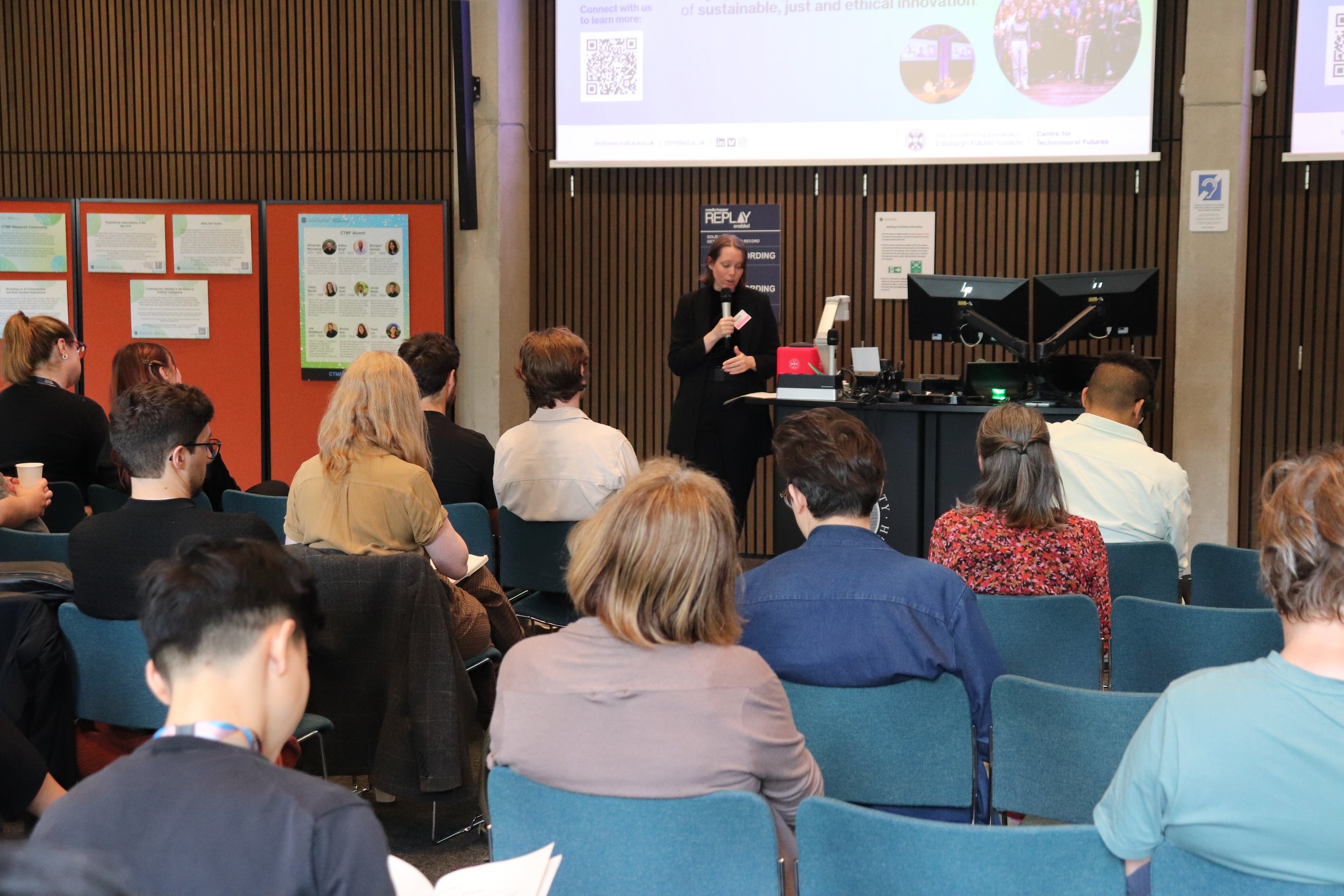
Dr Emily Sullivan addresses attendees at the second annual CTMF Research Showcase.
Q: Many people are excited about AI, while others are worried. What are the most important questions society should be asking as these technologies become more powerful?
Emily: There is no doubt that AI has great potential, and in many ways the new developments are very exciting. In my own work, I research the ways AI is changing science, and there are groundbreaking scientific discoveries that would not have been possible without these new technologies.
That said, there are also many risks and troubling developments associated with the rapid adoption of large language models across almost every sector.
Some of the critical questions at the heart of our research at CTMF include: How does AI automation affect human agency? How does AI threaten knowledge integrity and undermine our knowledge ecosystem? How can we protect against threats to human rights through increased surveillance and data extraction? What legal paths are available to realign the use of AI systems with the security of democratic norms? How destabilising is the concentration of wealth and power in just a few technology companies? And in what ways is AI contributing to climate collapse?
One issue that will become increasingly important is the vulnerability of our knowledge ecosystem as AI use grows.
Over the past ten years, we have come to understand all too well how important shared, trusted sources of knowledge are for political stability. With AI flooding online sources with generated content, the risk of misleading and manipulative information is at an all-time high. This is not just a matter of AI introducing unintentional errors, but also the ease and speed with which bad actors can generate realistic yet false content.
At the same time, studies have raised concerns about the cognitive offloading that can happen when using large language models, potentially affecting our ability to critically assess this changing knowledge ecosystem.
How can we maintain not only the integrity of our knowledge ecosystem in the face of AI, but also our individual cognitive capacity and intellectual freedom, so that we do not offload all our thinking to those who control AI systems?
Q: Your work brings together people from very different backgrounds, from philosophers to computer scientists. Why is it important to have those different perspectives in conversations about AI?
Emily: AI is touching every aspect of society. It is changing healthcare, business, education, the economy, social relationships and more.
This means that technology is not just a computational system built by engineers; it is a sociotechnical system that requires a multifaceted approach to its implementation and design.
We need legal scholars to understand the complexities of how we should regulate AI – and where regulation isn’t the right tool. We need philosophers to consider its ethical implications and think about how we can retain our humanity while using this technology. We need cultural linguists to understand how language models can encode bias and undermine cultural traditions. We need scientists who understand both how AI can propel discovery and the risks it poses for science.
All these aspects are interwoven. To address any real problem involving AI, we need to draw on expertise from a variety of disciplines and approaches.
We don’t just ask critical questions; we also seek solutions to how we might design or regulate technology to address the risks associated with AI. Achieving both of these aims requires interdisciplinarity.
One way CTMF stands out is that it is a truly interdisciplinary research centre. Too often, interdisciplinarity can mean people working next to each other within their own individual disciplines without really engaging with one another. At CTMF, researchers work together, combining the strengths of different disciplines to solve complex problems and collaborate on joint projects.
The humanities, in particular, are all too often cast aside or forgotten in interdisciplinary centres. At CTMF, we recognise that the humanities provide a valuable perspective on these complex social questions, because a future worth wanting is one that holds on to what is human and reflects the values we want to strive for – and that we want technology to embody.
Q: If you could leave alumni with one thought about the future of AI, what would it be?
Emily: We should not fall prey to narratives driven by big technology companies about inevitability and rapid adoption.
We have an opportunity to decide what values, as a society, we want to hold on to and move towards. We have seen the power of standing up to technology that conflicts with our values and human flourishing, most recently with social media bans for children.
We do not have to take the bad with the good. We can create safeguards and regulate technology in ways that allow us to benefit from it without letting go of our core values.
We hope that at CTMF we can contribute to this goal by researching AI futures that align with human values and put human flourishing at the forefront.
More information
For more information on the CTMF and how to support its development, contact Felicia Murray: felicia.murray@ed.ac.uk
Head to Enlightened to read more stories and news from the University of Edinburgh’s global alumni community and from across the University.